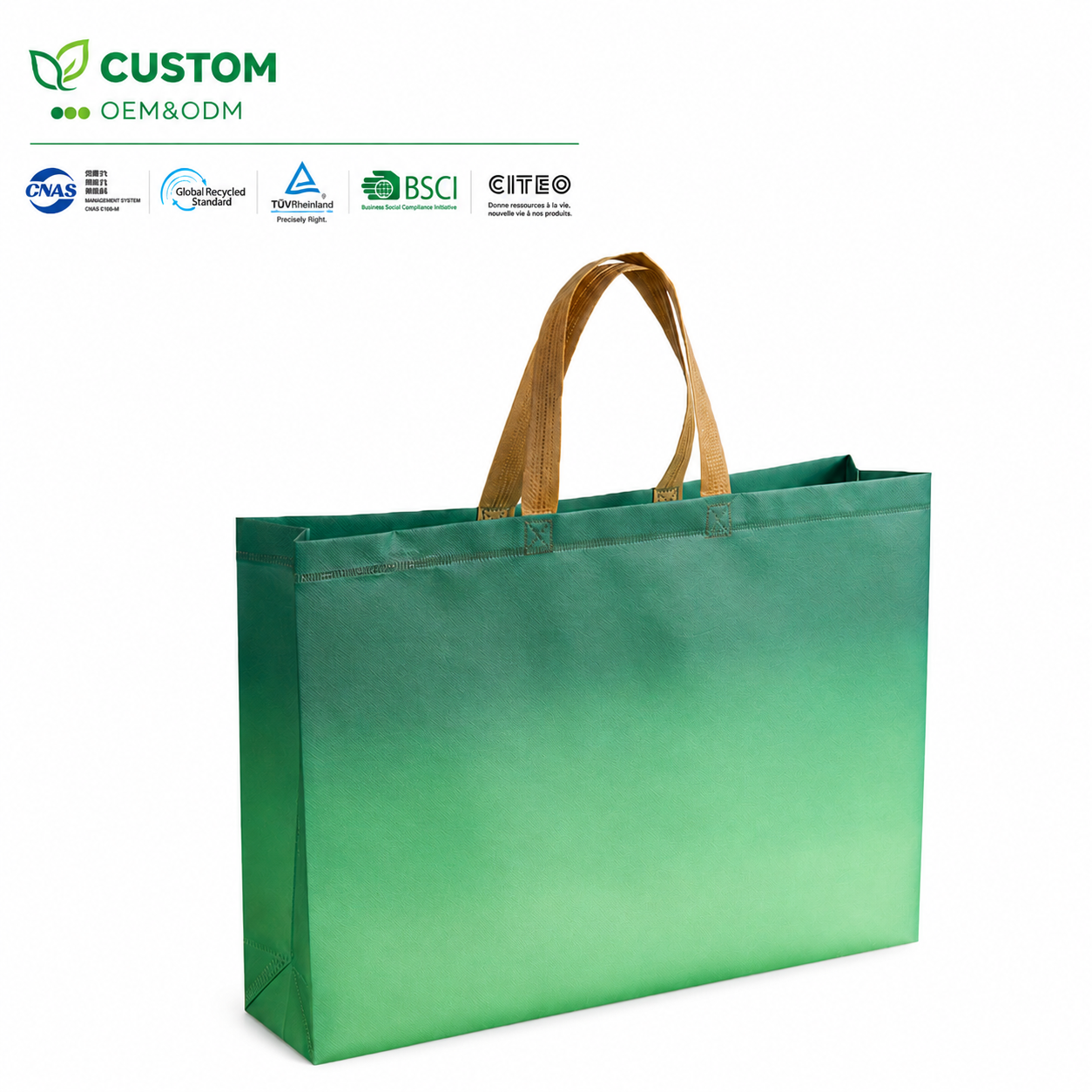
Non woven shopping bags offer a versatile, eco-friendly packaging solution, but that sentence carries a condition most catalogs leave out. The environmental case for any reusable carrier depends on how many times it actually gets used before it leaves circulation. A Norwegian life cycle assessment of grocery carrying solutions found that a PET multiuse bag needed roughly eight trips to match the impact profile of the single-use alternative it was displacing, while a cotton bag needed far more. Those thresholds are not arguments against non woven. They are arguments against treating “reusable” as a material property rather than a use-phase outcome.
The material gets a bag into the conversation. The construction, the fabric weight, and the handle attachment decide whether it stays in the rotation long enough to matter. A lightweight bag that tears at the weld on the fifth trip never reaches the break-even point, no matter how favorable its fiber origin looks on a spec sheet.
Most grocery-oriented non woven bags start with polypropylene spunbond. It is the default because the process is mature, the fabric takes print well, and the weight range covers the carry loads a grocery transaction produces. But the family does not stop there. Recycled PET non woven, usually written as RPET, enters the same conversation with a different story: the fiber comes from post-consumer bottle streams, and the fabric tends to carry higher tensile values at a given weight than standard PP spunbond. Bamboo fiber and laminated variants exist as well, each with its own cost and hand-feel profile.
The practical distinction is not “good material versus bad material.” It is which material matches the bag’s job. A promotional giveaway expected to survive a handful of trade shows does not need the same substrate as a grocery carrier that will be folded into a cart, loaded with cans, and hung on a door handle for a week. The GSM number, grams per square meter, is the first dial. A 60 to 70 GSM PP fabric sits at the light end. The 80 to 100 GSM band is where most grocery programs land. Above 100 GSM, the bag starts to feel like a tote rather than a carrier, which changes how customers fold and store it.
A frequent specification error is treating GSM as a comfort or premium signal. In non woven construction, it is closer to a load rating. A 100 GSM PP bag rated for a 5 kg carry will often show handle tear-out well before the fabric itself fails; 80 GSM is generally not sufficient for loads above 3 kg when the handle is ultrasonically welded without reinforcement tape. The failure mode is almost always at the attachment point, not across the body panel. The weld zone in a typical ultrasonic attachment is narrow, and dynamic load, the swing and jolt of a real shopping trip, concentrates stress there far faster than a static load test predicts.
Testing standards matter here, and they are not interchangeable. Woven substrates are commonly checked under ASTM D5034 for tensile strength, while non woven materials are tested under ISO 9073-3 strip method. The two methods produce different absolute numbers, which is a regular source of confusion when buyers compare datasheets from different suppliers. A bag that passes a grab test on a woven sample is not automatically validated for a spunbond non woven construction.
The table below pulls reference figures for non woven PP and RPET from commercial sourcing guides. It is not a declaration of superiority. It shows the trade-offs a grocery buyer is actually choosing between when the spec sheet lands on the desk.
| Parameter | Non woven PP (spunbond) | RPET non woven |
|---|---|---|
| Typical fabric weight | 60–120 GSM | 75–200 GSM |
| Reference load capacity | 3–5 kg | 5–10 kg |
| Expected use cycles | 50–100 uses | 200+ uses |
| Indicative FOB at 1,000 pcs | lower per-unit band | higher per-unit band |
| Recycled content claim | not applicable unless recycled PP | GRS certification possible, often 50% or higher |
| Main limitation | handle weld can fail under dynamic load | higher unit cost, supply depends on bottle stream availability |
The cost per use gap is smaller than the unit price gap suggests. A bag that costs less but cycles out after a few dozen trips can end up costing more per shopping trip than a heavier substrate that stays in service for years. That is the calculation grocery chains tend to miss when procurement is measured on the purchase order rather than the replacement cycle.
A grocery chain in a hot, humid coastal market ran a reusable non woven program through a summer season and started seeing handle separation at a rate that did not show up in the lab. The bags had been specified at a mid-range GSM with ultrasonically welded handles, and the static load test had passed comfortably. What the lab did not replicate was the combination of a bag sitting in a delivery van through an afternoon, then getting lifted by one handle with several kilograms of groceries inside. The weld zone had softened enough in the heat that the peel strength dropped, and the dynamic lift finished the job. The fix was not a heavier fabric. It was a switch from a welded attachment to a sewn and bartack-reinforced handle on the affected SKU, plus a narrower storage temperature window in the distribution brief.
That episode says something about how non woven bags fail in the field. The material is rarely the culprit. The interface between materials, the weld, the seam, the handle tape, is where the variables stack up. Laminated non woven adds another layer to that interface: the BOPP film can bond cleanly at room temperature and then lose peel strength when a container sits above 45°C in transit, producing a blister that looks like a print defect but is a bond failure.
Non woven is not indestructible, and the sustainability case weakens if the bag is treated as disposable. PP non woven softens above 60°C, so hot water washing and high-heat drying can deform the fiber structure. Strong alkaline detergents attack the polymer chain and leave the fabric brittle. A bag that gets machine-washed on a heavy cycle every week will not deliver the same cycle count as one that gets spot-cleaned and air-dried. Those are real constraints, and a grocery program that communicates them to customers gets more useful life out of the bag than one that prints “machine washable” on the gusset and lets the customer figure out the rest.
RPET is not a free upgrade either. The recycled content is only as traceable as the supply chain behind it. GRS certification requires a minimum recycled content threshold, and the paperwork has to follow the fiber from the bottle stream to the finished bag. Without that chain of custody, “recycled” becomes a word on a hangtag rather than a verifiable material fact.
The difference between a bag that works in a trial and a bag that works across a thousand checkout lanes is dimensional repeatability. A gusset that runs a few millimeters shallow or a handle attachment that sits a few millimeters low can change how the bag sits in a rack, how it folds, and where the stress lands. Zhejiang Huaqing Package, known in sourcing circles as Huaqing Package, operates non woven and flexible packaging production with an emphasis on dimensional consistency across runs. For grocery programs that need the same bag to behave the same way in a store in one region and a store in another, that consistency is the part of the specification that does not show up on a datasheet but shows up every day at the register.

Leading eco-friendly packaging bags manufacturer in China. We offer custom non-woven, PP woven, and cooler bags in bulk. OEM/ODM & fast global shipping.
No. 2774-2936 Jianxing East Road, Lingxi Town, Cangnan County, Wenzhou City, Zhejiang Province,China
Copyright © 2026 By Zhejiang Huaqing Package Co.,Ltd Privacy Policy
 EN
 Hot News