A logo printed on a carryout bag seems like a small detail. In practice, it is one of the highest-leverage brand investments a food business can make. Unlike a digital ad that disappears after a scroll or a billboard that stays in one place, a branded carryout bag moves through the world. It enters offices, apartments, cars, and public spaces. It gets seen by roommates, colleagues, neighbors, and strangers on the street. Each viewing is an impression, and impressions accumulate into recognition.
The economics of this are striking. According to the ASI 2026 Ad Impressions Study, a single branded bag generates nearly 5,000 impressions over its lifetime at a cost-per-impression of roughly one-tenth of a cent. That places branded bags among the most cost-efficient promotional products available, outperforming pens, T-shirts, and many digital ad formats in both longevity and visibility.
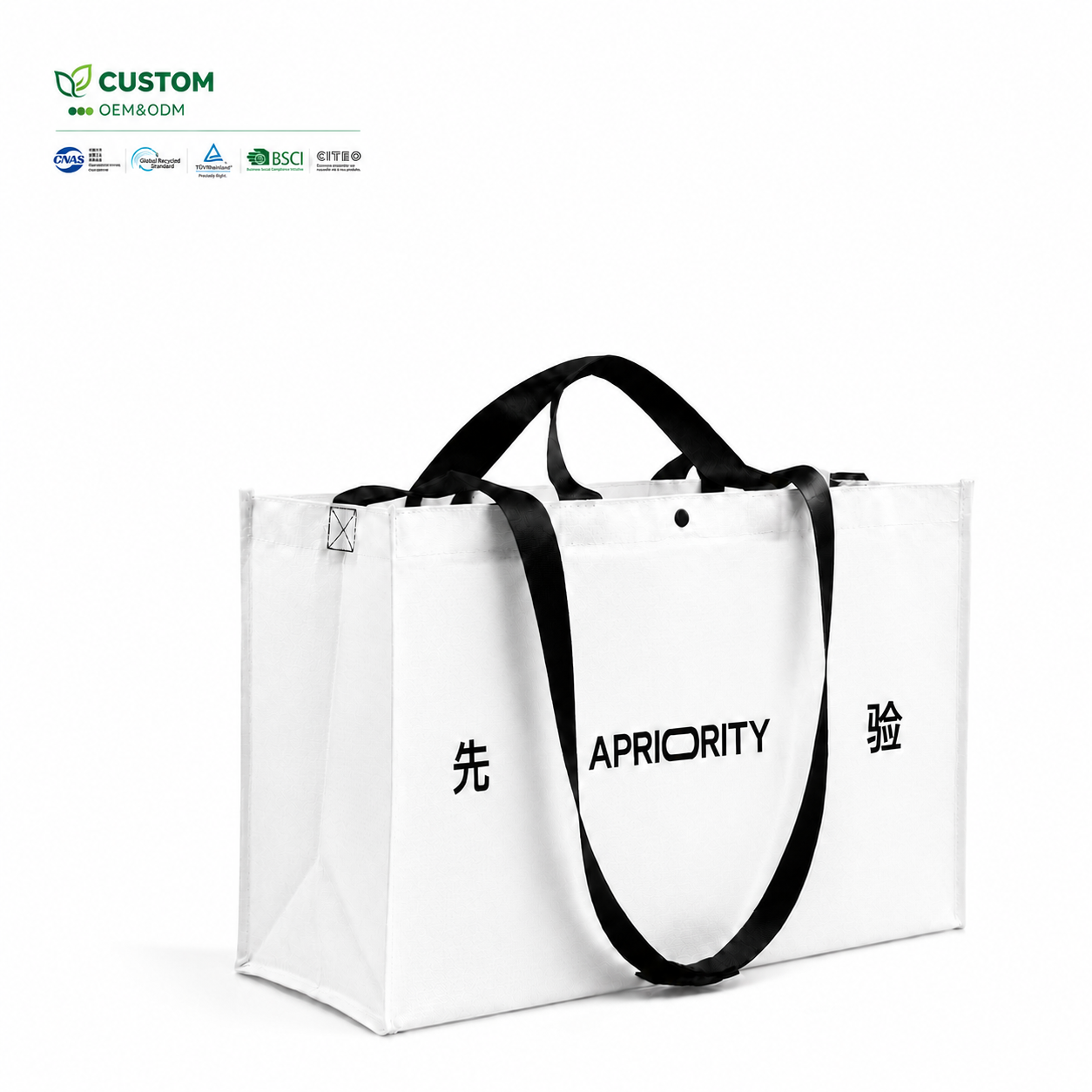
Not all logo placements are created equal. The most effective position for a logo on a carryout bag is high on the front panel, centered or slightly offset toward the handle. This ensures that when the bag is carried at a natural height, the logo sits at or near eye level for anyone approaching from the front.
Size matters just as much as position. A logo that occupies less than 15% of the available panel space tends to get lost, especially in crowded environments or at a distance. The ideal range is typically between 20% and 35% of the panel area, depending on the complexity of the design. Simple, bold logos scale well; intricate designs with fine lines or small text become illegible when viewed from more than a few feet away.
Color contrast is the third critical factor. A logo printed in a color that closely matches the bag material will fade into the background. High-contrast combinations like white on dark kraft, black on light paper, or a bright accent color on a neutral field ensure that the mark remains visible across varying lighting conditions. Metallic inks can add a premium feel but require careful handling to maintain legibility.
The substrate onto which a logo is printed determines how sharp the final result will be and how long it lasts. Smooth, coated papers accept ink with greater precision, producing crisp edges and consistent color saturation. Uncoated or textured papers absorb more ink, which can cause slight bleeding at the edges, but they also communicate a natural, artisanal quality that appeals to certain brand aesthetics.
Ink type also plays a role. Water-based inks are common for paper bags and are considered more environmentally friendly, but they may not adhere as well to coated or laminated surfaces. Solvent-based or UV-cured inks offer better adhesion and greater durability, particularly important for bags that will encounter moisture or grease.
A casual dining brand in the southeastern United States discovered the importance of ink selection when its first run of custom carryout bags arrived with logos that smudged after minimal handling. The issue traced back to an ink formulation that was incompatible with the bag's grease-resistant coating. Switching to a UV-cured ink resolved the problem entirely, and subsequent batches maintained their appearance through the full range of real-world conditions.
Customizing carryout bags with a logo involves more than sending a design file to a printer. Several technical considerations determine whether the final product matches expectations.
File format matters. Vector files like AI, EPS, or PDF preserve the logo's integrity at any size, whereas raster files like JPEG or PNG can become pixelated when enlarged. Most packaging manufacturers require vector files to ensure clean reproduction.
Color matching is another common pitfall. A logo that appears one way on a computer monitor may print differently on paper due to variations in color profiles, substrate absorption, and ink formulations. Requesting a physical proof before full production run is standard practice and essential for avoiding costly surprises.
Bleed area and safe zone are technical terms that non-designers often overlook. The safe zone is the area where critical design elements like the logo must stay to avoid being cut off during trimming. The bleed area extends beyond the final cut line to account for minor shifts during manufacturing. A competent packaging partner will provide clear specifications for both.
A logo alone communicates a brand name, but it doesn't tell the full story. The most effective carryout bags use the logo as an anchor and build additional brand language around it.
Color blocking, pattern placement, and typographic treatments can all reinforce the brand's personality without overwhelming the primary mark. A coffee shop might use a subtle stripe pattern in its signature color across the bottom of the bag. A bakery might incorporate a delicate illustration of wheat stalks along the side panel. A fast-casual chain might print a concise tagline that captures its value proposition.
These secondary elements serve two purposes. They make the bag more visually interesting, increasing the likelihood that it will be noticed and remembered. They also provide additional cues that help customers associate the bag with the brand even when the logo isn't directly visible.
Research from the promotional products industry shows that 85% of consumers remember the advertiser who gave them a promotional bag. That recall rate is remarkably high, and it underscores the value of treating the carryout bag as a complete brand communication tool rather than a logo delivery vehicle.
Sustainability has become a significant factor in how consumers evaluate food brands. A 2025 McKinsey survey found that 51% of consumers rank environmental impact as extremely or very important when it comes to packaging. A joint NIQ and McKinsey study found that 92% of shoppers say sustainability matters when choosing a brand.
These preferences translate directly into packaging decisions. Carryout bags made from recycled content, certified sustainable sources, or clearly labeled as recyclable signal to customers that the brand shares their values. This is not a niche concern; it is mainstream consumer behavior.
The trade-offs are worth acknowledging. Sustainable materials sometimes cost more or have different performance characteristics than conventional options. A bag made from 100% recycled paper may have slightly less tear strength than virgin fiber paper. A compostable bag may require specific conditions to break down properly. Being transparent about these trade-offs builds trust rather than undermining it.
A noodle shop chain in the Pacific Northwest tested this directly. The chain switched from conventional kraft bags to bags made from 100% recycled content with clear recyclability labeling. Customer feedback was overwhelmingly positive, and the change became a talking point in online reviews. The operational cost increase was modest, but the brand perception benefit was substantial.
Customizing carryout bags for foodservice use requires a partner that understands the specific demands of the industry. Food packaging must meet food contact regulations, withstand temperature variations, resist grease and moisture, and maintain structural integrity during transport.
Not all packaging manufacturers are equipped to handle these requirements. Some specialize in retail or promotional bags that never encounter hot food or condensation. Others focus on industrial packaging where aesthetics are secondary. Finding a manufacturer with experience in foodservice ensures that the logo customization process accounts for these functional needs from the start.
Zhejiang Huaqing Package Co., Ltd has developed expertise across the full spectrum of foodservice packaging. The company's manufacturing processes accommodate a wide range of materials, coatings, and printing techniques, allowing brands to achieve their desired visual outcomes without compromising on performance. Quality control measures are embedded throughout production, ensuring that logos appear consistently from the first bag to the last.
The customized carryout bag represents a rare opportunity in foodservice marketing: a physical asset that generates impressions long after the meal has been consumed. Getting the customization right, from logo placement to material selection to production quality, transforms a simple bag into a enduring brand ambassador.

Zhejiang HuaQing Package provides custom non woven bags, canvas bags and different kinds of bags for global brands. ISO900l and GRS-certified, 25+ years'experience, 5000+ clients. Request a quote today!
No. 2774-2936 Jianxing East Road, Lingxi Town, Cangnan County, Wenzhou City, Zhejiang Province,China
Copyright © 2026 By Zhejiang Huaqing Package Co.,Ltd Privacy Policy
 EN
EN
 Hot News